
Wild Wheat Paste Poster Advertising in 2026: A Game Changer for Brands
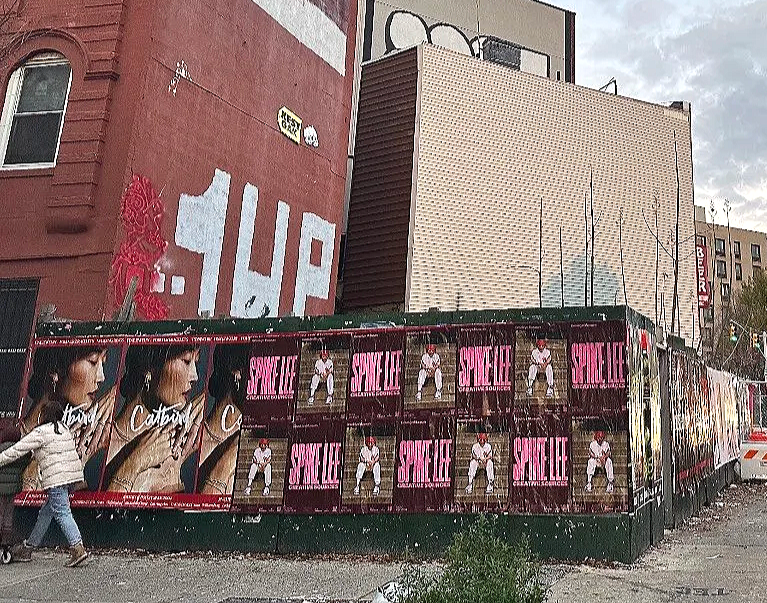
Wild wheat paste poster advertising campaign showcasing how brands use street-level posters in 2026 to achieve high visibility, repetition, and real-world impact in urban environments.
What we’re seeing across campaigns in 2026 is simple: digital media is louder, pricier, and easier to tune out than it was even a year ago. CPMs fluctuate, feeds refresh in seconds, and “attention” often means a thumb pause that never turns into memory. Brands come to Sidewalk Signal Marketing with a familiar question: how do we show up in a way people actually notice, remember, and talk about? Wild wheat paste poster advertising keeps growing because it lives where people already are. On sidewalks, near venues, outside cafés, along campus paths, at the corners where a neighborhood’s culture is made in real time. When physical street marketing is done correctly, it creates visibility that can’t be skipped, muted, blocked, or scrolled past. Everything in this article comes from what we execute at Sidewalk Signal Marketing, not theory.
What wild wheat paste poster advertising actually is
Wild wheat paste poster advertising (often called wheatpasting or wild wheat paste posting) is a street-level out-of-home format where printed posters are installed directly onto urban surfaces using wheat paste, a biodegradable adhesive traditionally made from flour and water. At Sidewalk Signal Marketing, we install campaigns on pedestrian-facing walls, construction barricades, plywood, brick, concrete, and other street surfaces where people naturally move and pause.
The “wild” part matters. This format doesn’t feel like rented media space. It feels culturally embedded because it sits inside real neighborhood texture: layered walls, creative corridors, nightlife streets, and campus zones where people already expect visual expression.
A good wheatpaste campaign is intentionally raw without being careless. The posters look hand-placed because they are. That human signal is a big reason the medium resonates in 2026, especially with audiences who have learned to ignore perfect, platform-native ad creative.
How Sidewalk Signal Marketing executes wheatpaste campaigns
At Sidewalk Signal Marketing, we treat wheatpaste like a disciplined media channel, not a random poster drop. Every rollout starts with a plan that connects your audience, your geography, and your timeline.
We begin with location strategy and neighborhood selection: where your audience walks, where they wait, where they meet friends, where they line up, where they take photos. Then we map pedestrian flow and sightlines so posters land where people will actually register them.
From there, we focus on repetition and saturation. One poster is a moment. A pattern of posters becomes familiarity, and familiarity is what converts “I saw that” into “I know that.”
After a paragraph like this, here’s how we typically structure execution:
Zone mapping
Route timing
Wall and surface selection
Density planning
Photo documentation
That structure is also where poster sizing becomes a strategic decision, not a production detail. Size changes how a campaign reads, how far it carries, and how dominant it feels in the street.
Poster sizes and why they matter in 2026
Poster size is one of Sidewalk Signal Marketing’s core levers because it affects readability, distance visibility, and perceived dominance. In 2026, where people are overstimulated and moving quickly, scale is not aesthetic fluff. Scale is performance.
We commonly work with two primary sizes because they solve different problems:
24×36 is built for density. In tight urban grids with lots of walls and lots of foot traffic, repeated 24×36 placements create a drumbeat of recognition. People see the same image again and again within a few blocks, which is exactly how you get recall without asking for a click.
48×72 is built for impact. It reads from farther away, claims big surfaces, and turns a single placement into a landmark. In high-visibility corridors, along long construction fences, or on broad blank walls, a 48×72 can outperform multiple smaller posters because it dominates attention.
In our work at Sidewalk Signal Marketing, “right size” always depends on the city layout and the audience’s pace. A fast-moving corridor with long sightlines wants different sizing than a nightlife block where people linger outside venues.
A quick sizing guide we use with clients
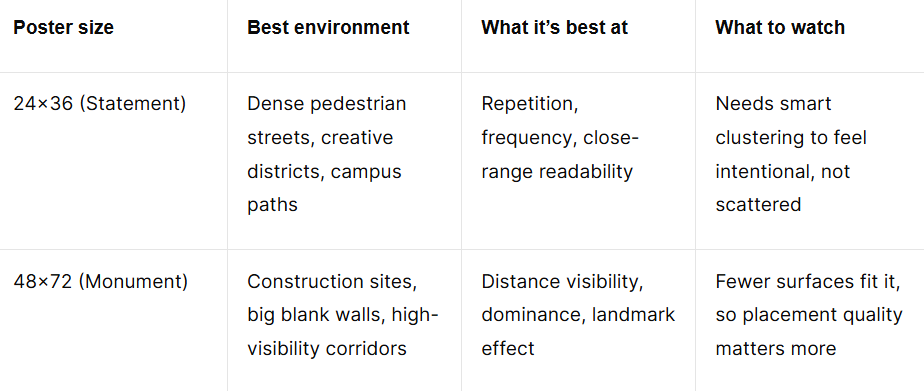
Poster size guide chart outlining common wild wheat paste advertising poster dimensions, including 24×36 and 48×72 sizes, used for urban foot traffic marketing campaigns.
When brands ask us what size they “should” choose, our answer is usually: you choose a mix based on the street. Sidewalk Signal Marketing recommends sizing based on foot traffic, available surfaces, how far viewers will be from the wall, and what you need the campaign to do (rapid awareness, event turnout, launch legitimacy, or sustained recognition).
Why wild wheat paste poster advertising works in 2026
In 2026, trust is harder to win on screens. People have been trained to doubt what follows them around the internet, and many actively try to reduce screen time. Print and physical media benefit from that mood shift. One widely cited 2025 Harris Poll result reported that a large majority of adults say print feels more authentic than digital campaigns, and we see that mindset play out on the street every week.
Wild wheat paste works because repeated exposure happens at human scale. You’re not asking someone to opt in. You’re placing the message along routes they already repeat: coffee runs, gym walks, subway exits, venue lines, campus shortcuts. After a few days, posters stop being “an ad” and start being part of the neighborhood’s visual language.
Sidewalk Signal Marketing consistently observes a few street realities that brands love:
Posters become landmarks people use to orient themselves.
Posters turn into conversation starters, especially in nightlife corridors.
Posters create photo behavior when the design is bold and the placement is confident.
Once installed, the campaign runs 24/7. No algorithm changes. No auction volatility. No creative fatigue caused by frequency caps. The wall holds the line.
Physical street marketing vs. digital advertising (how we think about it)
We’re not anti-digital at Sidewalk Signal Marketing. Many of our strongest campaigns pair wheatpaste posters with paid social, search, creator partnerships, or email. The difference is that street presence changes how digital performs because it changes what people feel about the brand.
Digital ads are fleeting. They rely on platform rules, competitive bidding, and a moment of attention that can disappear with a swipe. Wheatpaste posters create unavoidable presence in real environments, and that presence tends to make your online touchpoints feel more credible.
After a paragraph like that, here’s how we frame the tradeoffs for brand teams:
Digital: fast optimization, precise targeting, easy A/B testing
Wheatpaste: high recall, public legitimacy, repeated exposure in natural routines
Together: street visibility supports search lift, social proof, and “I’ve seen this” recognition
In practice, we often see posters drive branded search and higher engagement on launch posts because the audience is not meeting the message for the first time online.
The brands that use wild wheat paste posters
Sidewalk Signal Marketing works with brands that need cultural proximity and fast recognition. The format excels when you want to look present in a city, not merely targeted to it.
Fashion brands use wheatpaste because repetition and style language matter. A strong visual placed repeatedly at street level becomes part of the neighborhood’s aesthetic, and sizing decisions matter here: 24×36 often wins in dense shopping areas, while 48×72 makes sense when a brand wants a bold statement near a flagship moment.
Music artists and entertainment campaigns thrive on street discovery. Posters near venues, rehearsal spaces, and nightlife routes catch people in the exact mindset where plans get made. Event brands also benefit from how quickly wheatpaste can build awareness inside a few key blocks, especially when the campaign saturates the approaches to the location.
Startups use wheatpaste for legitimacy. When you show up physically, you look established. For many early-stage teams, the goal is not only reach, it’s credibility, and a 48×72 placement in the right corridor can do what weeks of impressions sometimes fail to do.
Where wheatpaste campaigns perform best
We see the strongest results in places where walking is the default and neighborhoods have clear cultural lanes. Major cities are obvious winners, but it’s not only about population. It’s about pedestrian density, dwell time, and wall inventory.
Creative districts, nightlife corridors, retail strips, and campus zones consistently perform because people move slowly enough to read and repeat routes often enough to remember. College towns can outperform expectations because the same audience cycles through the same streets daily, which makes repetition incredibly efficient.
Sidewalk Signal Marketing adjusts both poster size and density by market. A compact downtown with abundant surfaces might call for heavy 24×36 repetition across a tight grid. A mid-size market with fewer walls can benefit from selective 48×72 placements that act like anchors, supported by smaller posters placed along feeder routes.
Why brands choose Sidewalk Signal Marketing
Brands choose Sidewalk Signal Marketing because we manage wheatpaste campaigns end to end, and because we treat sizing and placement as strategy, not decoration. We plan, produce, install, document, and report so your campaign looks intentional in the street.
We also operate with nationwide reach and local execution teams, which matters when you want consistency across cities. A multi-market rollout only works when the work looks like one campaign everywhere it appears, with sizing decisions adapted to each city’s layout and pedestrian behavior.
Just as important, working with Sidewalk Signal Marketing keeps campaigns from feeling random. Wild posting can look messy when it’s not planned. When it’s executed with structure, it looks confident, culturally fluent, and unmistakably present.
Is wild wheat paste poster advertising still relevant in 2026?
Yes, and demand keeps rising.
As digital spaces get noisier, physical advertising becomes more valuable because it feels real. Wheatpaste posters meet people away from the feed, in the middle of life, in the neighborhoods that shape taste. The medium also continues to modernize through trackable QR codes, custom landing pages, and creative that’s designed for both street photos and in-person readability. Sidewalk Signal Marketing keeps investing in this channel because we keep seeing what brands want most in 2026: attention that holds, visibility that doesn’t depend on a platform, and a public presence that audiences can actually feel.
If you’re planning a 2026 launch, tour, drop, or expansion and you want your message to live in the real world, Sidewalk Signal Marketing can help you map the right neighborhoods, choose the right poster sizes, and build the kind of saturation that turns walls into memory. Reach out to Sidewalk Signal Marketing and we’ll plan a wheatpaste campaign that people notice on day one, and still recognize a week later.
info@sidewalksignal.com
www.sidewalksignal.com
